Guides
European Accessibility Act compliance checklist
Check whether your service is in scope for the European Accessibility Act, how EN 301 549 maps to WCAG 2.1 / 2.2 AA, and what evidence to prepare for EAA compliance.
By Eivind Pihl Martinsen, Synli.aiLast updated August 23, 2026

The European Accessibility Act (EAA), Directive (EU) 2019/882, is the first EU-wide law that requires private-sector products and services to be accessible. It applies in EU member states from 28 June 2025. This checklist explains who is in scope, how the technical requirements map to WCAG, and what to actually do — without the fear-based framing competitors lean on.
Law versus standard: EAA and EN 301 549
Keep the law, standards and web guidelines separate. The EAA sets accessibility requirements for specified products and services. Under EAA Article 15, a presumption of conformity arises only for requirements covered by a harmonised standard whose reference has been published for the EAA in the EU Official Journal. EN 301 549 v3.2.1 is currently harmonised for the Web Accessibility Directive; it is useful technical guidance, but not yet an EAA presumption route.
- EAA (2019/882)The law — what must be accessible, applies from 28 June 2025
- EN 301 549ICT requirements; v3.2.1 is OJEU-harmonised for WAD, while an EAA revision is in progress
- WCAG 2.1 / 2.2 AAWeb-content criteria used as part of a broader product or service assessment
Who is in scope
- Products: computers and operating systems, smartphones, TVs with digital services, payment terminals, ATMs, ticketing and check-in machines, e-readers.
- Services: e-commerce, consumer banking, electronic communications, e-books, passenger transport information and ticketing services, and access to audiovisual media services.
- Microenterprises providing services (fewer than 10 staff and under EUR 2 million turnover) are largely exempt; manufacturers and most online shops are not.
- The EAA is separate from the Web Accessibility Directive (2016/2102), which covers public-sector websites and apps. Many organisations fall under both.
A note for Norwegian organisations
Norway is in the EEA, not the EU. As of August 2026, implementation remains delayed in Norway, Iceland and Liechtenstein, and it is still unclear when the EAA will enter the EEA Agreement and Norwegian law. Businesses operating only in Norway remain subject to the current Norwegian ICT rules: covered private websites use 35 Level A and AA criteria from WCAG 2.0, covered private apps use 29 WCAG 2.1 requirements, public websites use 48 WCAG 2.1 requirements, and public apps use 42. A Norwegian business offering an EAA-covered product or service to EU consumers must assess and meet the applicable rules in those EU markets; being established outside the EU is not by itself an exemption.
The practical checklist
- Confirm scope and jurisdiction: identify the product or service category, EU markets, national implementing law, exemptions and any disproportionate-burden assessment.
- Choose a web implementation target such as WCAG 2.2 AA, then map it to the other applicable EAA product, service, information and documentation requirements.
- Run automated checks for supported deterministic failures such as contrast, programmatic names, form labels and selected ARIA patterns.
- Do human review for judgement-based criteria: meaningful alt text, reading order, error recovery, authenticated flows.
- Document conformance: keep technical evidence and, where required, an accessibility statement.
- Set up monitoring: accessibility regresses with every release — re-scan on a schedule, not once.
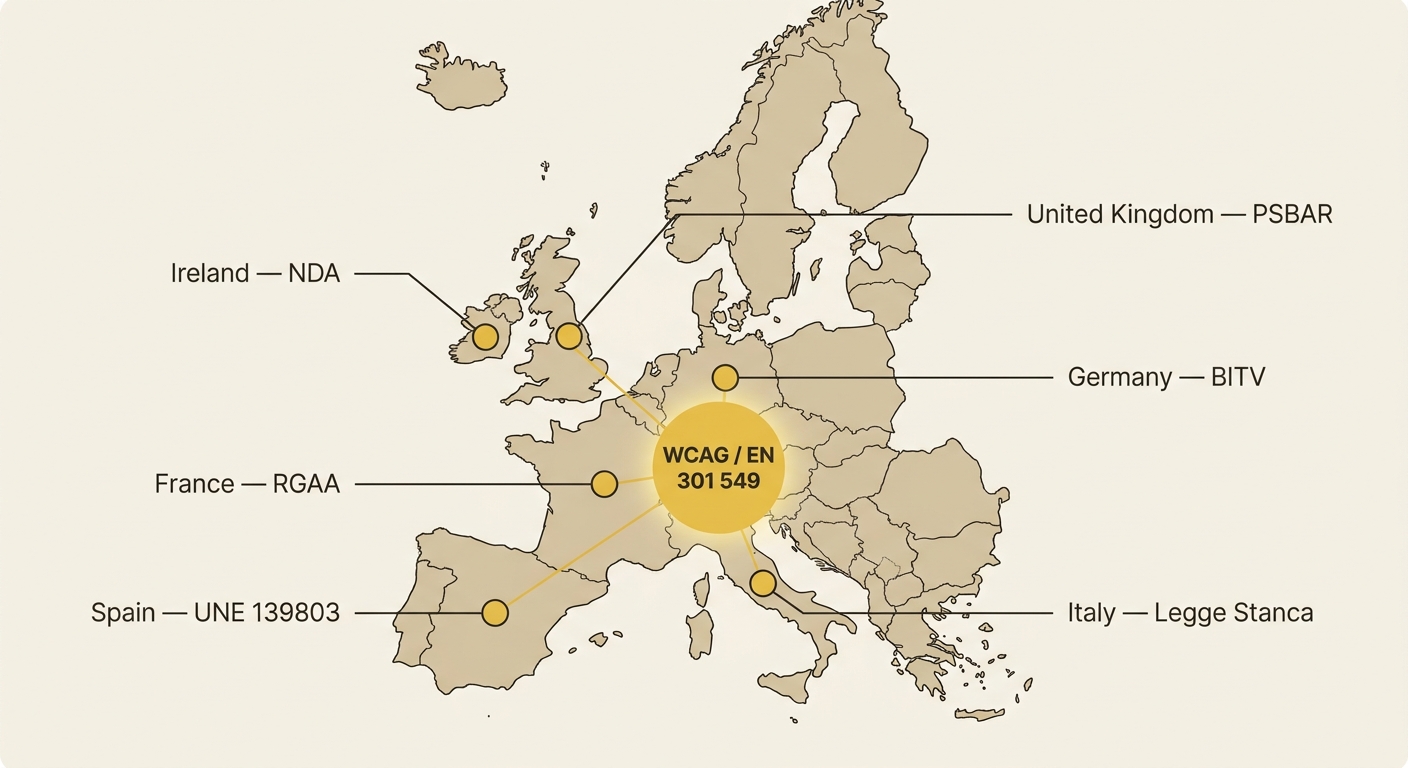
National frameworks across the EEA build on the same core
If you operate across borders, you will meet national instruments with their own scope, exemptions, supervisory bodies and documentation rules. WCAG and EN 301 549 provide a useful technical core for web work, but WCAG conformance alone does not establish compliance with every national instrument or the EAA's wider product and service requirements.
- Germany — BITV 2.0: federal ordinance for accessible ICT, EN 301 549 / WCAG-aligned.
- France — RGAA: a public-sector referential with an explicit national test catalogue mapped to WCAG success criteria.
- Spain — UNE 139803: the UNE standard expressing ICT accessibility requirements, aligned with international practice.
- Italy — Legge Stanca (Law 4/2004) and AgID: WCAG-level requirements plus national monitoring and self-declaration.
- Ireland — NDA Code of Practice and the Irish statutory instrument transposing the Web Accessibility Directive (same WAD / EN 301 549 family).
- United Kingdom — PSBAR 2018 (the Public Sector Bodies Accessibility Regulations, sometimes written PSBR) plus the Equality Act 2010 duty. The UK is outside the EU/EEA but uses the same WCAG family.
FAQ
Can an EAA checker confirm legal compliance automatically?
No. An EAA checker can help identify technical accessibility issues and organise evidence, but the European Accessibility Act also depends on scope, product or service category, national implementation, documentation, and human judgement. Automated results are a starting point, not legal advice.
What standard should an EAA accessibility scan use?
EN 301 549 is an important technical reference, but v3.2.1 is currently harmonised for the Web Accessibility Directive, not as the EAA standard. The EAA-supporting revision is still in the standards process. WCAG 2.2 AA is a useful web implementation target, not an automatic EAA compliance result.
Who needs to prepare for the European Accessibility Act?
Many private-sector services sold to EU consumers are in scope, including e-commerce, consumer banking, electronic communications, passenger transport information, e-books, and some digital products. Microenterprises providing services have exemptions, but online shops and manufacturers often still need to assess their obligations.
Sources
- Directive (EU) 2019/882 — EAA (EUR-Lex)
- WAD standards and EN 301 549 harmonisation (European Commission)
- EN 301 549 V4 work item for EAA support (ETSI)
- Directive (EU) 2016/2102 — Web Accessibility Directive (EUR-Lex)
- EAA status in Norway (Uutilsynet)
- Germany — BITV 2.0 (gesetze-im-internet.de)
- France — RGAA (numerique.gouv.fr)
- United Kingdom — PSBAR 2018 (legislation.gov.uk)